The Biogerontology Research Foundation (BGRF) and Oxy Wave Foundation have organized and are leading an international research collaboration focused on a fundamental challenge for deep-space exploration: protecting astronaut health through the environments crews live in. The collaboration's new preprint, Radiation Countermeasures for Deep-Space Exploration: An Integrated Hypoxic Radioprotection Framework, places controlled oxygen environments, mitochondrial resilience and biological radiation protection at the centre of that effort.
For the Biogerontology Research Foundation (BGRF) and Oxy Wave Foundation, this is a critically urgent astronaut-health priority. We argue that controlled hypoxic habitat engineering should be developed as a fundamental part of the health infrastructure for long-duration spaceflight, rather than left at the margins of mission design. In our view, its biological rationale, potential for monitored and reversible use, and prospect of economically practical implementation warrant much greater scientific attention, funding and integration into mission planning, backed by a development programme aimed at deployment.
Organized by the two foundations, the effort features co-authors from NASA Johnson Space Center, Cedars-Sinai Medical Center, the University of Pittsburgh and the Broad Institute of MIT and Harvard; the Belgian Nuclear Research Centre SCK CEN, Ghent University, Loma Linda University Health and the University of Innsbruck; the Central Research Institute of Electric Power Industry (CRIEPI), Kindai University and Universidad de Antofagasta; and Aegis Aerospace, Oxyesta Ltd, Longevity Industry Analytics and Deep Knowledge Group. Together, the co-authors bring perspectives from radiation biology, space medicine, oxygen physiology and ageing research to a shared habitat-engineering challenge.
The paper is the basis for a programme of engagement across applied research, science, medicine and industry: refining the concepts, developing experimental partnerships, mobilizing funding and working toward deployment through staged biological, human-performance and systems validation.
Making atmosphere engineering central to astronaut health
Oxygen sustains life, but it also participates in the chemistry of radiation damage. When radiation produces unstable molecular fragments, oxygen can help turn some initially reversible injuries into more persistent damage. This is known as the oxygen-fixation effect.
Oxygen modulation therefore connects habitat engineering directly with biological response. Cabin oxygen does not equal tissue oxygen: gas concentration, cabin pressure, breathing, circulation and local metabolism all influence what cells experience.
The framework addresses both acute solar particle events and the continuing mixed-particle challenge of galactic cosmic radiation. Because oxygen-dependent effects vary with particle type, energy and tissue conditions, testing must establish the protection achievable in each setting.
The paper argues that atmosphere control belongs in the core design of the protection system, planned together with shielding, dosimetry, storm sheltering and biomedical countermeasures. The crew's living environment becomes an active part of astronaut-health engineering, not a variable left outside the radioprotection strategy.
Two levels of atmosphere control
The framework has two linked levels. The first is gradual adaptation to a moderately reduced-oxygen habitat. The second is a temporary, more pronounced reduction during solar-particle-event sheltering, when the crew would already be in a physically protected space with reduced activity.
The research proposal discusses approximately 16-12% oxygen for the baseline range under controlled normobaric conditions, and approximately 9-10% for short, monitored sheltering exposures. These are experimental research windows whose safety, duration and biological value must be established together. Percentage alone does not define an equivalent exposure at a different pressure.
The proposed validation programme treats radiation protection and operational performance as joint requirements. It examines cognition, sleep, cardiovascular function and work capacity alongside biological injury, with individual monitoring and rapid restoration of oxygen built into the research design.
Fire-safety testing must examine ignition, materials and emergency procedures at the intended cabin pressure and gas composition. Biological protection and engineering safety therefore advance through an integrated research programme.
A human signal from Axiom Mission 1
The preprint also reports preliminary human data on blood indicators of senescent cell abundance, collected from three of the four astronauts who flew Axiom Mission 1 — the first all-private crewed mission to the International Space Station, launched in April 2022. Samples were taken before launch and after return to Earth. The study, one of roughly 25 research investigations carried on that flight, was led by James L. Kirkland and Tamara Tchkonia, whose group contributed the findings here. It connects spaceflight physiology with a major concern in ageing research: cellular senescence.
Senescent cells are cells that enter a persistent growth-arrested state. Depending on their context, they can release inflammatory and tissue-modifying signals. Researchers therefore examine both changes within cells and circulating factors associated with this state.
In the astronaut samples, the authors measured senescence-associated gene expression in CD3+ T lymphocytes, a group of immune cells, alongside circulating cell-free mitochondrial DNA and several senescence-associated secretory phenotype factors. The results include post-flight increases in markers from the p16INK4a/p14ARF locus, and the cell-free mitochondrial DNA and secretory factors were elevated in all three astronauts on return. The figure distinguishes the comparisons that reached the study’s statistical threshold from those that did not.
The cell-free mitochondrial DNA findings are notable because they tie the paper’s two mechanistic threads together: cellular senescence and mitochondrial dysfunction. Ionising radiation is a well-established inducer of senescence, and senescent cell burden is one of the routes by which cumulative exposure is thought to translate into long-term harm. A measurable rise across a short mission would make senescence a candidate endpoint rather than an abstract risk — something a future countermeasure could be tested against.
The small sample makes this an exploratory signal, not a population-wide estimate of how much astronauts age in space. It also cannot separate radiation from the other stresses of the mission. The value lies in identifying biological changes and measurements that larger studies can investigate.
Looking beyond a single marker
The second supplementary figure examines circulating factors associated with the senescence-associated secretory phenotype, or SASP, and with inflammation. Rather than relying on one measurement, it looks across a panel of signals that may help describe how the body responds to spaceflight.
Some of the displayed factors were elevated after flight; the wider heatmap includes changes in both directions. These molecules are not exclusive signatures of senescent cells, so they need to be interpreted alongside other biological and clinical evidence.
Importantly, the Axiom observations are not a test of the hypoxic-habitat proposal. The astronauts were not studied in a controlled comparison of the proposed atmosphere regimes. The observations motivate further investigation of cellular stress and recovery; they do not demonstrate that oxygen modulation prevents those changes.
This distinction gives the programme a practical direction: future experiments can measure radiation injury, mitochondrial function, immune responses and senescence-related endpoints together, rather than judging success from a single laboratory result.
From laboratory validation to mission deployment
The paper sets out four complementary stages of validation. Controlled ground-habitat studies would first examine adaptation, sleep, cognition and physiological responses to the proposed atmosphere conditions.
Radiation-biology experiments would then test cells and tissues under relevant radiation and oxygen conditions, measuring DNA damage, mitochondrial stress, repair and senescence-related changes.
Human operational analogues would examine whether people can sustain the necessary performance under realistic workloads and constraints. Integrated vehicle and mission simulations would bring atmosphere control together with radiation monitoring, sheltering procedures, carbon-dioxide management and emergency recovery.
These four prototypes provide a development route toward mission deployment: establish biological effect sizes, define workable oxygen exposures, verify crew performance and demonstrate reliable systems integration. Progression depends on meeting predefined safety and efficacy criteria, including the interaction of oxygen modulation with the rest of the countermeasure system.
A mission-health priority that needs investment now
For organisations planning sustained human activity beyond low-Earth orbit, radiation protection is a mission-design problem now, not a question to leave until a spacecraft is already built. Shielding mass, shelter geometry, life-support systems and human performance requirements are closely connected.
BGRF and Oxy Wave Foundation regard controlled hypoxic habitat engineering as an urgent, under-prioritized field. They argue that it has not yet received scientific attention, development funding or a place in mission planning proportionate to its potential. The foundations see the combination of oxygen-dependent radiation biology, experience with controlled hypoxic exposure and the prospect of practical habitat integration as a compelling basis for accelerated development. The objective is to build and validate a deployable astronaut-health capability.
The work also creates a research bridge to health on Earth. Oxygen sensing, mitochondrial quality control and cellular senescence matter in both space biology and ageing research. Lessons may inform separate terrestrial studies, but evidence from one setting cannot establish a longevity or therapeutic benefit in another.
From publication to collaboration and deployment
Led jointly by BGRF and Oxy Wave Foundation, the initiative is intended to catalyse a coordinated programme across applied research, science, medicine and industry. The foundations are using the preprint to engage space agencies, research centres, clinicians, habitat developers and commercial spaceflight organisations in refining the framework and translating it into testable systems. Oxy Wave Foundation provided support for the work.
The immediate priorities are to refine the oxygen-modulation concepts, agree experimental endpoints, establish prototype partnerships and mobilize funding for the four-stage development pathway. The aim is to move from a published framework to independently tested systems and, once performance and safety requirements are met, operational deployment. Prospective research and development partners are invited to contact the corresponding authors listed with the preprint.
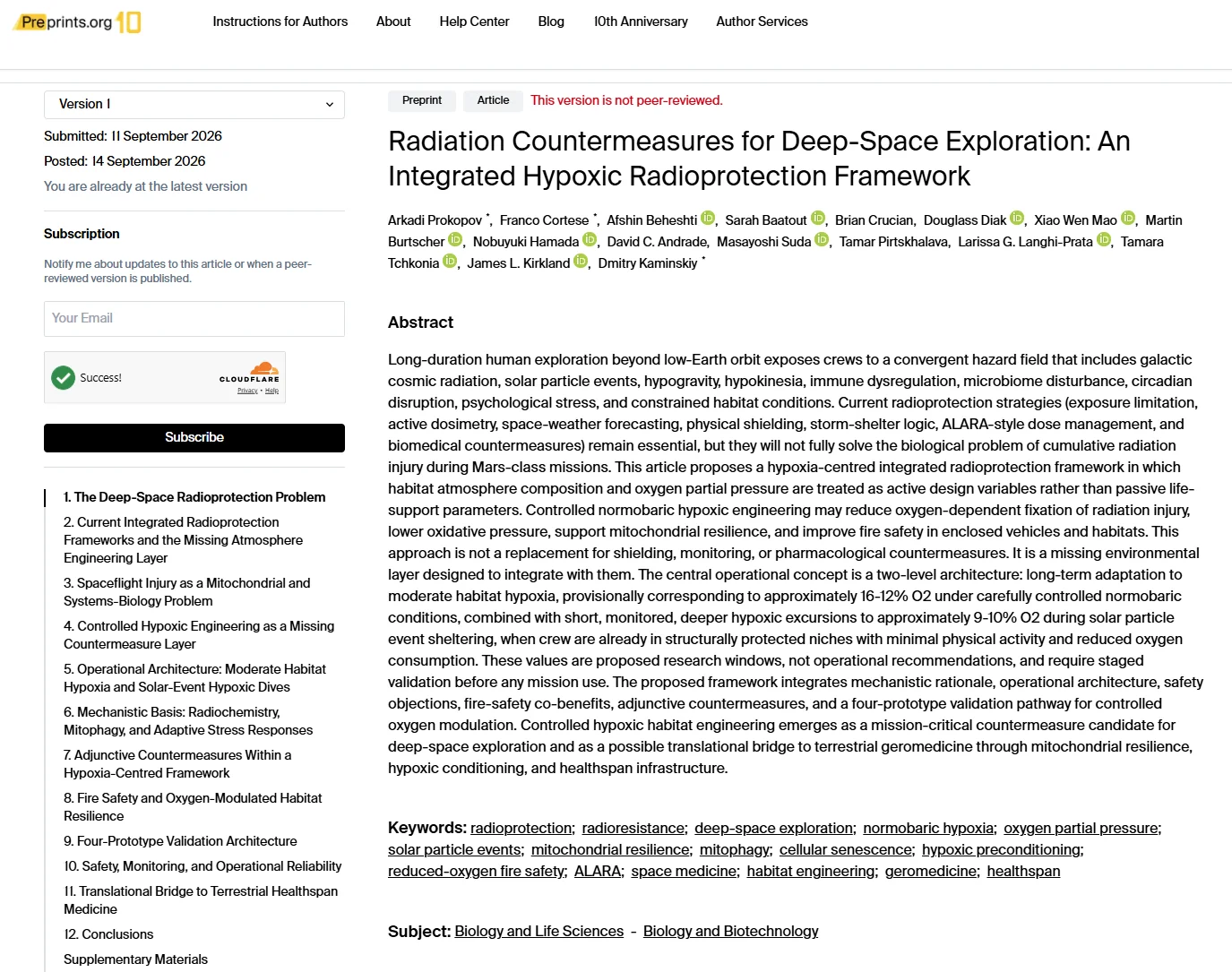
The co-authors
The collaboration brings together the following 16 co-authors, listed in manuscript order with their full affiliations. Affiliations identify the contributors and do not by themselves imply institutional endorsement of the proposed framework.
Source: Prokopov et al. (2026), Radiation Countermeasures for Deep-Space Exploration: An Integrated Hypoxic Radioprotection Framework. Conceptual illustrations: visual adaptations of the paper's figures (CC BY 4.0). Supplementary illustrations: original data panels in styled layouts. Captions are plain-language descriptions.