Mechanism and measurement
Mitochondrial medicine, IHHT and HBOT device research, and the biomarker frameworks that make effect demonstrable.
One page covering both what we study and how we study it — the mechanism beneath the work, the research programmes running on it, and the evidence they produce.
Mitochondrial dysfunction sits beneath most age-related disease. That is why programmes across very different conditions share a common scientific foundation. Mitochondria generate the energy every cell depends on. When their function declines the consequences appear as apparently unrelated conditions — cognitive decline, metabolic disease, infertility, fatigue, immune dysfunction and reduced physical capacity.
Treating that common substrate, rather than each downstream condition separately, is why a single mechanism programme can serve autism research, neurodegeneration, fertility and metabolic health at the same time.
Mitochondrial medicine, IHHT and HBOT device research, and the biomarker frameworks that make effect demonstrable.
Lyme, autism, neurodegeneration, diabetes, fertility and the exposome — six conditions sharing one mechanism.
Space medicine, longevity habitats and hypoxic radioprotection.
The veterinary trial, techno-philanthropy and the ICD-11 policy programme.
Establish what is happening at cellular level and which part of it is modifiable.
Turn the mechanism into a defined, repeatable intervention with dosing, sequencing and contraindications.
Test in cohorts with measured endpoints, and publish what results.
Move validated protocols into clinics, and into the classification and policy work that makes them fundable.
Our work appears in Oncotarget, Scientific Reports, Experimental Gerontology, Human Gene Therapy and Rejuvenation Research, among others, alongside chapters in the standard reference works in gerontology and longevity medicine.
The Foundation's lead scientific priority: comprehensive research into intermittent hypoxic-hyperoxic training devices and protocols, with dedicated testing of machines and protocols against a validated evidence base.
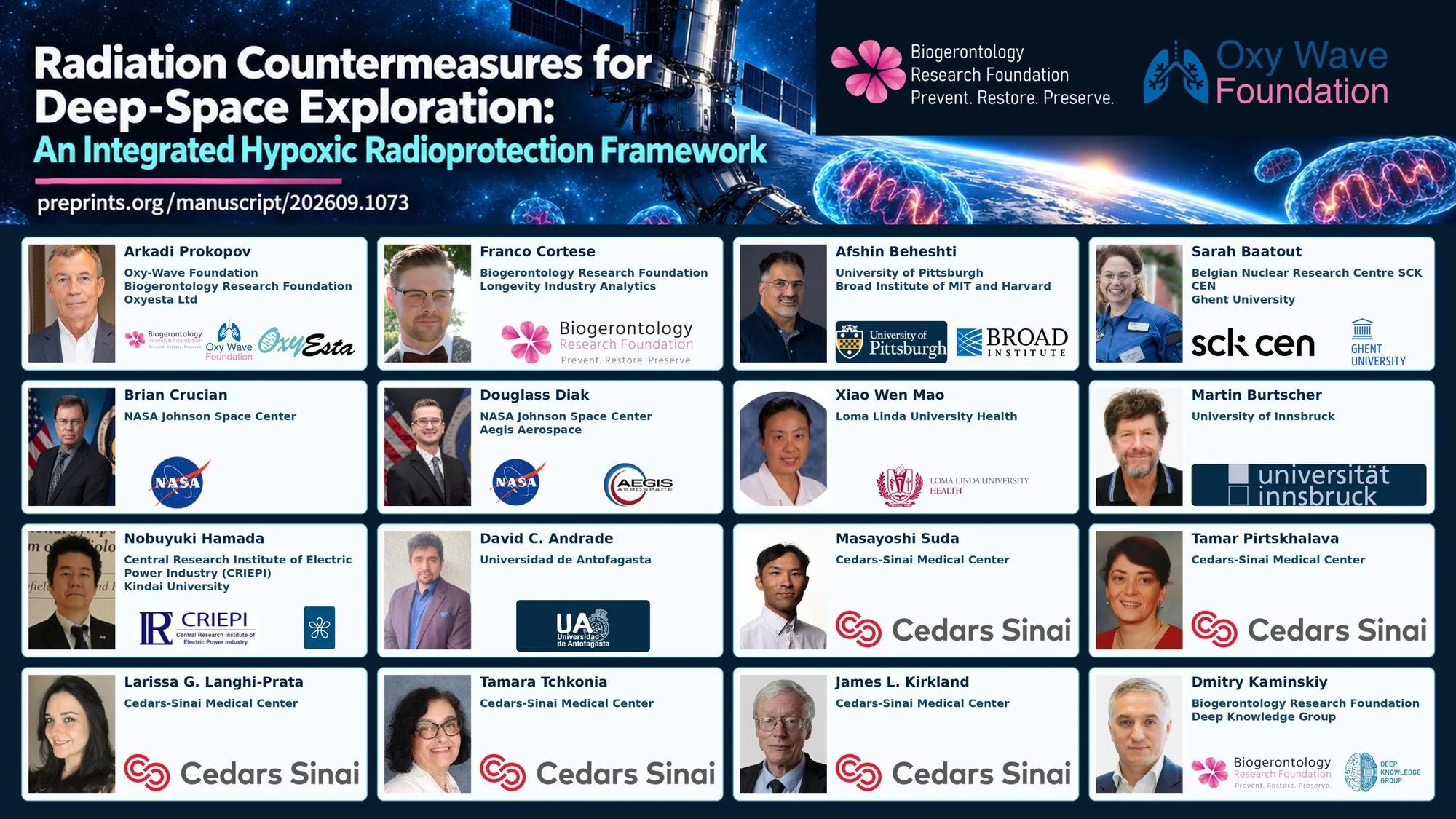
The Biogerontology Research Foundation and Oxy Wave Foundation lead a 16-author international collaboration, with co-authors from NASA Johnson Space Center, Cedars-Sinai and the Broad Institute, proposing controlled hypoxic habitats as a core part of radiation protection for deep-space crews.
Oxygen and CO₂ modulated in cycles
Hypoxia-inducible response activated
Biogenesis and rejuvenation
Immune, vascular and glymphatic gains
IHHT applies increasing levels of controlled stress by manipulating available oxygen and carbon dioxide. The result is mitochondrial rejuvenation and biogenesis, improved microcapillary health, glymphatic cleaning of the brain, and strengthening of the immune system — the cellular basis of both longevity and the treatment of major metabolic disease.
The same science supports two distinct protocol families: mild amplitudes for treating pathology, and high amplitudes for enhancement and resilience.
Hyperbaric therapy dominates the Western market through marketing rather than comparative evidence. Our programme tests that assumption directly.
| DIMENSION | IHHT | HBOT |
|---|---|---|
| Relative effectiveness | Baseline +20–30% | Baseline |
| Safety & side-effects | No pressurisation | Pressurisation risks |
| Cost & complexity | Lower, simpler | High cost, complex |
| Evidence base | Growing peer-reviewed | Established, widespread |
| Origin | Cosmonaut hypoxic training | Astronaut oxygen programmes |
Device research is only one layer. The protocol-personalisation infrastructure is a cornerstone of the programme, not an add-on.
The Foundation studies the full stack: the machines themselves, the protocol compositions they run, and the decision infrastructure clinicians need to apply them safely to individual patients.
Original hypoxic training developed through space medicine
Intermittent hypoxic conditioning enters wider clinical practice
Nobel Prize recognition of cellular oxygen sensing
Applied research, protocol optimisation and validation
Mitochondrial dysfunction underlying persistent symptoms.
Neuroprotection through improved cellular energy.
Metabolic recalibration via hormetic conditioning.
Chronic viral respiratory recovery and immune rebalancing.
We collaborate with researchers, clinicians, universities and institutions across every cluster in the portfolio.